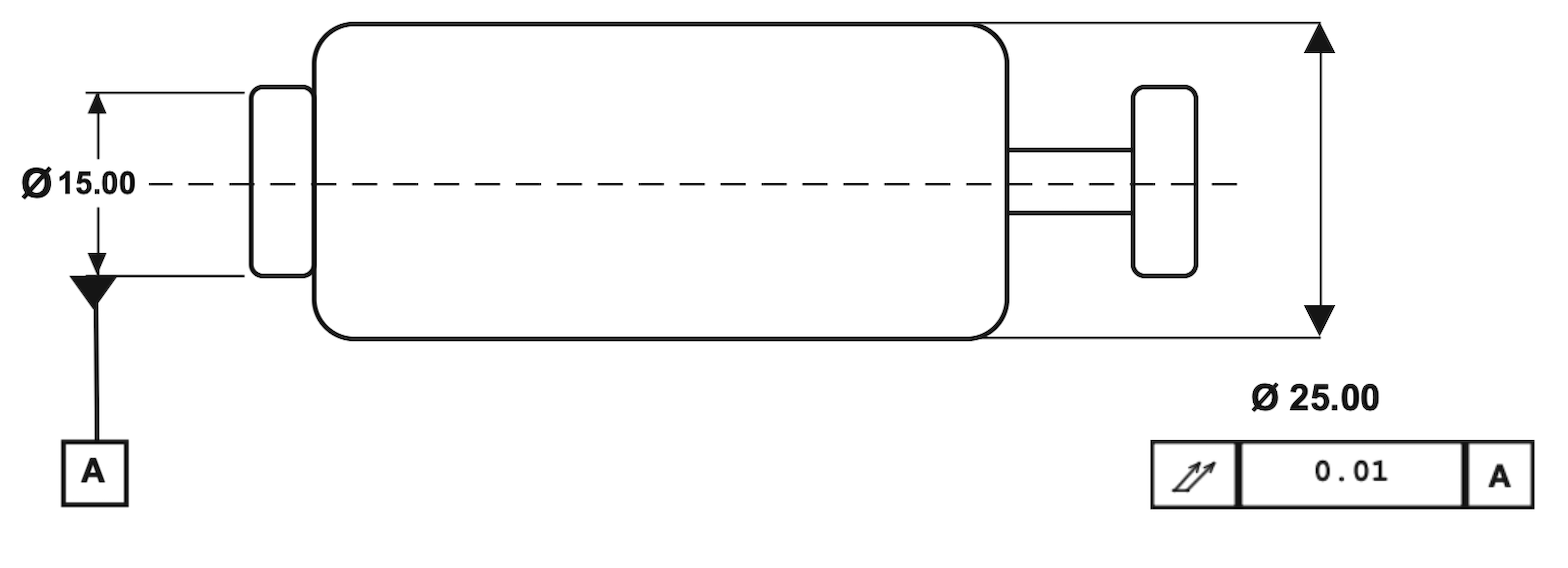
Controls
Total indicator movement swept across the entire surface — not just one slice — as the part rotates and the indicator traverses along the datum axis. For cylindrical surfaces it controls circularity + straightness + taper + eccentricity simultaneously. For flat faces it controls flatness + perpendicularity.
A part that passes circular runout at every slice could still fail total runout if the individual readings do not land in the same total band.
Example
A precision grinding spindle nose must satisfy total runout 0.005mm across its full cylindrical journal length. A single-slice runout check is insufficient because the grinding wheel follows the spindle path — any taper or bow compounds the size error. Total runout ensures the entire journal sweeps within one tight envelope.
Inspection
For face total runout: traverse the indicator radially across the face while rotating — the zone is two parallel planes perpendicular to the datum axis.
Datum & Modifiers
The datum axis defines the rotation axis and the direction of traverse. Typically a bearing journal or precision turned diameter.
Total runout is always evaluated regardless of feature size. MMC and LMC do not apply to any runout control.
Total runout is a stricter requirement than circular runout — where both are possible, start with circular runout unless the full-length envelope matters functionally.