Controls
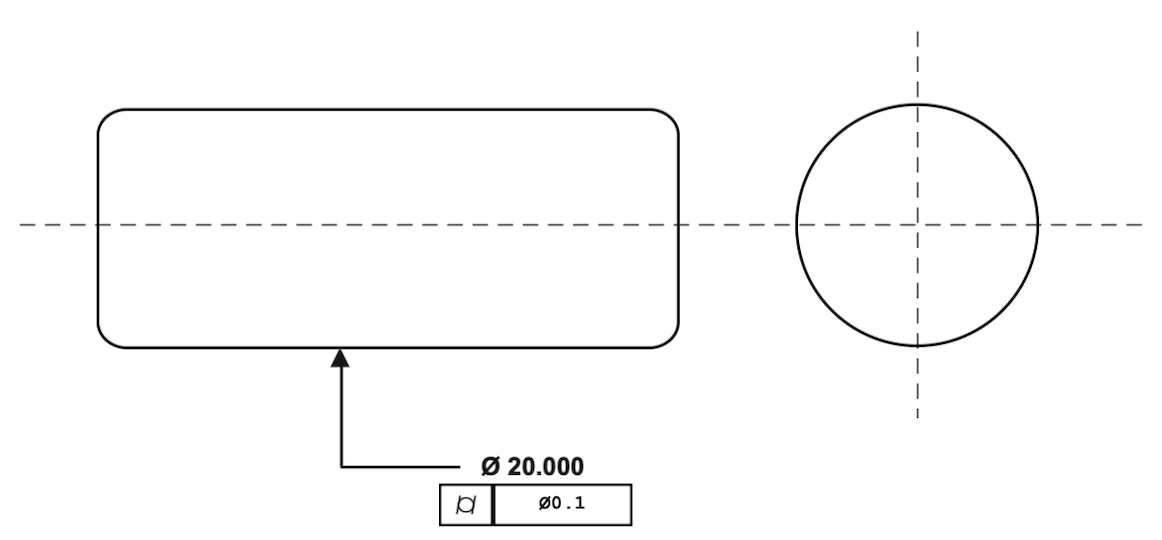
All points on an entire cylindrical surface must lie within the annular space between two coaxial cylinders separated by the tolerance value. Cylindricity simultaneously combines circularity (roundness at each slice), straightness (axis deviation) and taper (diameter variation along the length).
It is the most comprehensive form control for cylinders — if cylindricity passes, circularity and axis straightness are implicitly satisfied.
Example
A precision hydraulic piston bore requires cylindricity 0.005. The seal must see a consistent cylindrical surface across its entire stroke — an out-of-round or tapered bore causes the seal to flex unevenly, accelerating wear and eventually causing fluid bypass. Circularity alone would not catch a bore that is round at each slice but tapered end-to-end.
Inspection
Datum & Modifiers
The cylindrical surface references its own best-fit axis — no external datum is needed.
Cylindricity is always RFS. It is a pure form control — MMC and LMC have no meaning here.