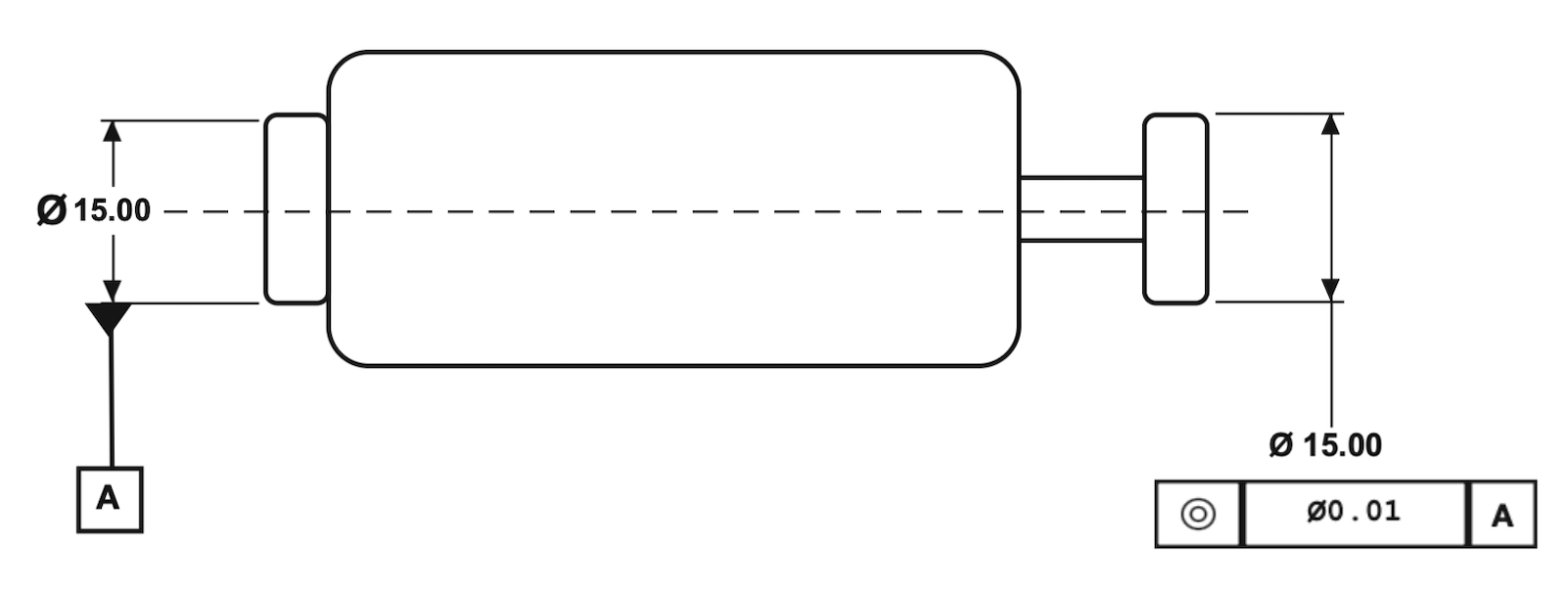
Controls
The median points — midpoints of diametrically opposed surface measurements — of a cylindrical feature must all lie within a cylindrical tolerance zone coaxial with the datum axis. It controls mass balance and centre-of-mass distribution, not the actual surface location.
Unlike runout, concentricity ignores surface variation — a perfectly eccentric but round feature could pass runout yet fail concentricity.
Example
A high-speed turbine rotor hub bore relative to the OD — if the mass centre is offset from the rotation axis, imbalance forces increase with speed. In practice, circular runout or true position is almost always specified instead, because concentricity is extremely difficult to verify and the measurement rarely represents the functional requirement.
Inspection
Inspecting concentricity to full rigour is one of the most complex CMM tasks in GD&T verification.
Datum & Modifiers
The datum defines the rotation axis. Without it, coaxiality cannot be assessed.
Concentricity is always evaluated regardless of feature size. MMC and LMC are not permitted.
Concentricity was removed from ASME Y14.5-2018. Use true position (RFS) or circular runout instead. Legacy drawings may still carry the callout.