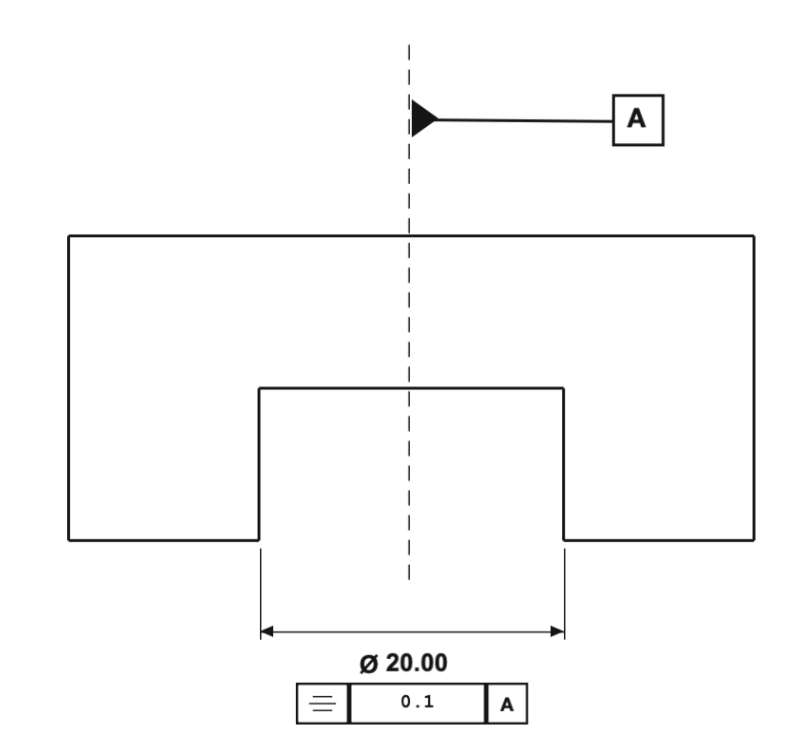
Controls
The median points of a feature — midpoints of paired surface measurements taken from opposite sides — must all lie within a tolerance zone of two parallel planes equally disposed about the datum centre plane. Controls mass distribution symmetry rather than surface position.
A feature can be offset as a whole (eccentric) but still pass symmetry if both sides are equally displaced from the datum — making it notoriously confusing to apply correctly.
Example
A keyway milled in a shaft must be centred within 0.05mm of the shaft's diametral midplane so that equal wall thickness is maintained on both sides, preventing the key from applying a side load. In practice, true position (RFS) is now used instead since ASME removed symmetry in 2018.
Inspection
Rigorous symmetry inspection is rarely done outside aerospace and defence contracts.
Datum & Modifiers
The datum centre plane is essential — it defines the plane of symmetry from which median points are measured.
Symmetry is always evaluated regardless of feature size. MMC and LMC are not permitted.
Symmetry was removed from ASME Y14.5-2018. Use true position (RFS) instead. Legacy drawings may still reference the callout.